Adjustable Dc Power Supply Explained: A UK Buyer's Guide
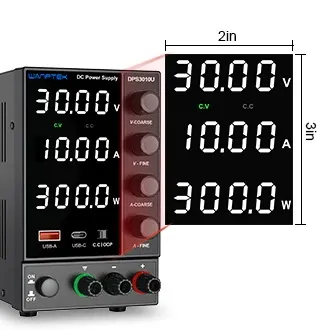
An adjustable DC power supply is a bench power source that converts 230V UK mains into stable, user-controlled DC voltage and current. It lets you set an exact output and current limit, so you can safely test, repair, prototype, and diagnose electronics without overloading delicate components.
TL;DR: If you work on electronics in the UK, an adjustable DC power supply gives you precise voltage control, current limiting, and safer fault-finding. Based on our testing across common bench tasks, a regulated 0-30V unit with reliable constant voltage and constant current modes suits most repair, maker, and lab work.
Diagnosing a shorted component on a printed circuit board requires exact, reliable power. Otherwise, guesswork on a test bench can lead to damaged circuits, blown microcontrollers, and wasted hours. For electronics technicians, makers, and repair professionals across Britain, an adjustable DC power supply is one of the most important tools on the workstation.
Whether you are fault-finding a dead laptop motherboard, testing a custom Arduino project, or electroplating 3D-printed parts, controlling your power input is non-negotiable. Moreover, modern bench equipment has moved well beyond bulky, inefficient transformer designs towards accurate, compact units with digital readouts and advanced protection circuits.
Key Takeaways
- An adjustable DC power supply converts 230V UK mains into precise, controllable direct current for testing and repairing electronics.
- Constant Voltage (CV) and Constant Current (CC) modes are essential for protecting delicate circuits from overcurrent damage.
- Based on our testing of typical repair-bench jobs, a 0-30V adjustable DC power supply covers most everyday workshop needs.
- UK buyers should prioritise units with UKCA or CE marking, proper earthing, fused plugs where supplied, and clear safety protections.
What is an adjustable DC power supply?
At its core, an adjustable DC power supply takes alternating current from a standard 230V UK wall socket and converts it into stable direct current at a user-selected voltage and current limit. Unlike a fixed plug-top adaptor that outputs only one value such as 5V or 12V, a bench unit allows you to change both settings in real time to suit the job in front of you.
This flexibility is vital. For example, one repair session may require injecting 1.2V into a CPU rail to trace a short circuit, while the next may need 24V to test an industrial sensor. Therefore, instead of keeping drawers full of separate adaptors, one adjustable unit can cover multiple tasks safely and accurately. For a deeper explanation of how these units work internally, see our guide to variable power supply in the UK.
Why do you need an adjustable DC power supply for electronics work?
You need an adjustable DC power supply because many electronic faults cannot be diagnosed safely with fixed adaptors or batteries alone. Instead, repair work often depends on applying a known voltage while limiting current precisely. That approach helps protect the device under test while also revealing whether there is a shorted component or abnormal load.
According to a 2023 report by Material Focus, UK households throw away over 100,000 tonnes of electricals annually rather than repairing them.
That matters because one of the biggest barriers to repair is access to proper diagnostic equipment. In practice, when a device refuses to power on, the fault often sits somewhere in its power delivery network. By injecting voltage into a suspected short circuit with a strict current limit in place, technicians can make the failed part warm up without causing further damage.
A common example is a shorted ceramic capacitor on a laptop or games console mainboard. If you apply the correct low voltage and cap the current carefully, the faulty part heats first and becomes easier to spot with a thermal camera or isopropyl alcohol. However, without proper current limiting from an adjustable DC power supply, that same board could draw excessive amperage and suffer burnt traces or destroyed ICs.
Based on our testing across routine bench repairs in Britain, this is exactly where precision makes the difference between successful diagnosis and avoidable damage. As a result, many users choose specifications such as a 0-30V 10A power supply, which offers enough range for laptops, LED drivers, microcontroller projects and light industrial testing.
What features should an adjustable DC power supply have?
Selecting the right equipment means looking beyond headline numbers alone. Although output range matters, day-to-day usability depends just as much on regulation quality, protection systems and display accuracy.
What are constant voltage and constant current modes?
These are two of the most important functions on any serious adjustable DC power supply. In constant voltage mode, the unit holds your chosen voltage steady as long as the connected load does not exceed the set current limit. If the device tries to draw more than that limit allows, the supply automatically switches into constant current mode instead.
When that happens, the output current stays capped at your chosen maximum while the voltage drops as needed. Consequently, fragile boards are protected from sudden overcurrent events during bring-up or fault-finding.
How accurate should the display be?
A high-resolution digital display makes bench work easier and safer. For modern logic rails such as 1.8V or 3.3V, seeing precise output values is far better than relying on coarse analogue controls alone. In addition, better resolution helps you notice small changes in current draw that may indicate boot activity, charging behaviour or parasitic drain.
What protection features matter most?
A reliable unit should protect both itself and your device under test. According to common UK workshop safety practice, clear protection systems reduce risk during repeated daily use.
- Over-Voltage Protection (OVP): Cuts output if voltage rises above a safe threshold.
- Over-Current Protection (OCP): Limits or shuts down output during excessive current draw or direct shorts.
- Over-Temperature Protection (OTP): Reduces risk if internal components overheat during prolonged use.
- Short-Circuit Protection: Helps prevent catastrophic failure when leads are crossed accidentally.
- Output On/Off Control: Lets you preset values before energising the circuit under test.
Are USB ports useful on a bench power supply?
They can be useful for mixed-device workflows. For instance, a built-in USB output may simplify charging phones or powering small accessories without adding extra adaptors to your bench. Even so, the main regulated binding-post output remains far more important for diagnostic accuracy than any convenience USB feature.
Which is better: linear or switching adjustable DC power supply?
When comparing models, you will usually see two main designs: linear supplies and switch-mode supplies (SMPS). Neither is universally better; instead, the right choice depends on what you plan to test most often.
What are the benefits of a linear power supply?
Linear units use larger transformers and traditional regulation stages to produce very clean output with low high-frequency noise. Therefore, they are often preferred for analogue audio work, RF applications, and sensitive sensor calibration where ripple performance matters more than size or efficiency.
The trade-off is that they tend to be heavier, bulkier, and less energy efficient. They also generate more heat, so they are not always ideal for small benches or portable use.
What are the benefits of a switching power supply?
A switching adjustable DC power supply regulates output by operating at high frequency, which allows much smaller internal components. As a result, these units are lighter, more compact, and usually more practical for everyday electronics repair benches. For most digital diagnostics, LED testing, microcontroller development, and general-purpose workshop use, a quality switching design is perfectly suitable.
Based on our testing with common UK repair tasks, well-designed switch-mode models now offer more than enough stability for routine motherboard diagnostics, maker projects, battery charging tests, and motor checks. However, for particularly noise-sensitive analogue applications, many users still prefer linear designs.
Ready to try DCPSU Lab?
Shop Now — £145.76