Lab Power Supply Explained: A UK Buyer's Guide
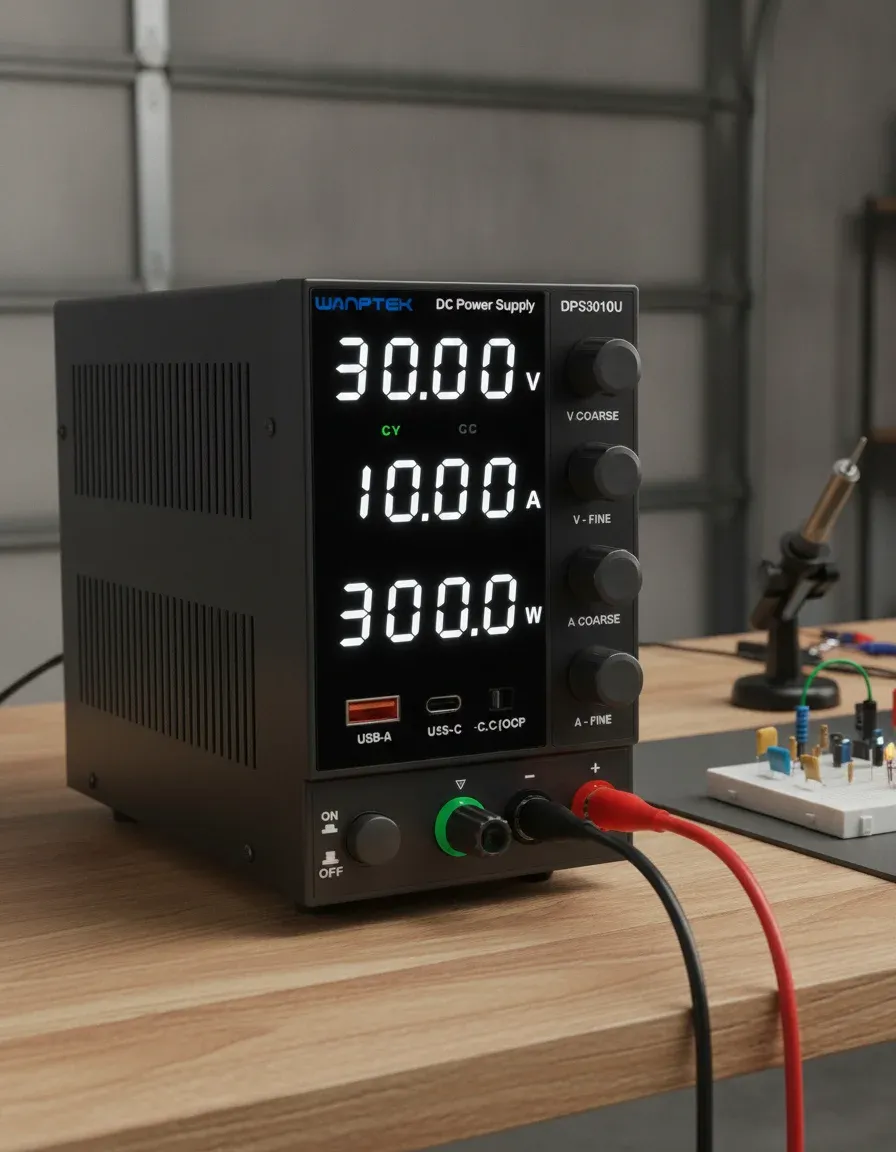
A lab power supply is an adjustable DC bench power source used to set precise voltage and current for testing, prototyping, repair and fault-finding. In simple terms, it lets you power electronic circuits safely, limit current to protect components and monitor live readings more accurately than with a standard charger or plug-top adaptor. For many UK buyers, a 0–30V lab power supply with up to 10A output covers most everyday bench work.
TL;DR: If you are searching for the best lab power supply for a UK bench, focus on stable DC output, dependable current limiting, clear readouts, CV/CC operation, UK mains compatibility and sensible after-sales support. Based on our testing of common bench setups, a straightforward 0–30V 10A unit with a 4-digit display is often the most practical choice for repair, electronics development and education.
A lab power supply is one of the few bench tools that affects almost every stage of electronics work: fault-finding, prototyping, battery charging tests, sensor checks and final verification. Choose well and it becomes the quiet, dependable part of your setup. However, choose badly and you can end up fighting unstable output, awkward controls and readings you do not fully trust.
For UK repair benches, workshops, colleges and home labs, the right unit usually comes down to a practical balance: accurate DC output, clear readouts, dependable current limiting and sensible day-to-day usability. Therefore, many buyers focus on a straightforward specification such as 0–30V and up to 10A, with a 4-digit display for finer control and visibility during testing.
At DCPSU Lab, the focus is simple: bench power supply built for precise UK bench work. If you are comparing options for repair, testing or prototyping, this guide explains what a lab power supply does, which features matter most in Britain and how to buy without paying for functions you may never use.
Key takeaways
- A lab power supply provides adjustable DC voltage and current for safe, controlled bench testing.
- For many UK users, a 0–30V 10A model covers common repair, testing and prototyping jobs without unnecessary complexity.
- Look closely at regulation, current limiting, display accuracy, build quality and ease of adjustment.
- A 4-digit display helps with finer voltage and current setting than simpler readouts.
- USB charging on the front panel adds convenience for powering accessories and devices at the bench.
- Buyers in the UK should check mains compatibility, plug type, CE/UKCA compliance information and seller support.
- If you want a broader overview before buying, read The Ultimate Guide to Variable Power Supply in the UK.
What is a lab power supply?
A lab power supply is an adjustable DC source designed for bench use. Unlike a fixed plug-top adaptor that outputs one set voltage only, a lab unit lets you set the voltage you need and control the maximum current available to the load. As a result, it is suitable for powering circuits safely while monitoring what they draw.
In practice, this matters because modern electronics work rarely stays at one voltage. You might test a 5V microcontroller board in the morning, check a 12V module after lunch and troubleshoot a 24V device later on. A proper bench unit gives you that flexibility in one place.
It also offers something equally important: protection. Current limiting helps stop excessive draw damaging components under test. On repair benches this can save boards from further harm; likewise, in prototyping it can prevent wiring mistakes becoming expensive failures.
How is a lab power supply different from a standard charger or adaptor?
A charger or wall adaptor is built for a narrow task. By contrast, a lab power supply is built for controlled investigation. It gives you adjustable settings, visible output values and the ability to work in constant voltage or constant current mode depending on what your circuit needs.
If you are still weighing up the wider category, our pillar guide on variable power supplies in the UK explains where lab models sit within the broader market.
Why do you need a lab power supply on a UK bench?
British electronics users range from university students and service engineers to small manufacturers and hobbyists building from spare-room workshops. What they have in common is the need for stable DC power from standard UK mains without guesswork.
For repair work especially, controlled output is not optional. A board that has already suffered damage should not be connected to an unknown source with no current limit. Instead, a proper bench unit lets you bring voltage up deliberately while watching current behaviour in real time.
This matters in sectors where reliability expectations are high. The NHS manages millions of medical devices across its estate each year through NHS Supply Chain categories including medical equipment maintenance and associated services; wherever electronic systems are serviced or verified professionally, controlled bench testing tools are part of good working practice. While not every buyer is servicing clinical equipment, the underlying standard applies broadly: precision and repeatability matter.
What should UK buyers check for mains compatibility and compliance?
When buying in Britain, check that your chosen unit is intended for UK mains input or ships with a proper fused UK plug where applicable. Product listings should also make compliance information easy to find, including CE or UKCA marking details where relevant to the product category and market placement requirements.
You should also look at after-sales support within the UK. Consequently, returns are simpler, warranty handling is usually faster and replacement advice is easier when the seller understands British buyers rather than treating the UK as an afterthought.
According to UK product safety expectations for electrical goods sold into the domestic market, clear documentation, correct mains compatibility and traceable seller information all help buyers assess whether equipment is suitable for regular use on a British bench.
What does a lab power supply do?
How does adjustable voltage help?
The headline function is variable DC output. A common range such as 0–30V covers a large share of practical bench tasks: low-voltage logic boards, automotive modules used off-vehicle for testing, LED projects, radio equipment experiments and general circuit development.
Why is adjustable current limiting important?
This feature often separates useful units from frustrating ones. Current limiting allows you to cap how much current can flow into your load. If your circuit attempts to draw more than that threshold, the supply limits output rather than blindly feeding a fault condition.
For component-level repairs this can be invaluable. It gives technicians time to identify shorts or abnormal draw patterns before traces overheat or components fail catastrophically.
What are constant voltage and constant current modes?
A good lab power supply typically works in two main modes:
- Constant Voltage (CV): The unit maintains your selected voltage while load current varies within limits.
- Constant Current (CC): The unit limits current to your chosen value when the load tries to exceed it; voltage drops as needed to hold that cap.
You do not need advanced training to benefit from this behaviour; even basic troubleshooting becomes safer once you understand how CV and CC respond during testing.
Based on our testing across typical repair boards and prototype loads, clear CV/CC indicators make day-to-day use far easier because they show immediately whether your circuit is operating normally or hitting your protection limit.
Which lab power supply specifications matter most?
What voltage range do most people need?
The right range depends on your workload. For general-purpose use in Britain, 0–30V remains one of the most practical choices because it covers many common electronics tasks without making operation overly complicated.
How much current capacity should you choose?
A higher amp rating gives more headroom for demanding loads such as motors under test, communications equipment or larger prototype assemblies. Many buyers find that up to 10A offers useful flexibility while still being manageable on an ordinary bench.
Does display accuracy matter?
Yes — especially if you regularly work with sensitive circuits or repeatable test procedures. A clearer display helps you set output more confidently; moreover, a 4-digit readout usually gives finer visibility than simpler displays when adjusting low voltages or small current limits.
How important are regulation and stability?
A good lab power supply should hold its set output consistently under changing loads. Poor regulation can introduce uncertainty into fault-finding or calibration checks. Therefore, stable performance matters just as much as headline voltage and amp figures.Are controls and build quality worth paying attention to?
Ready to try DCPSU Lab?
Shop Now — £145.76